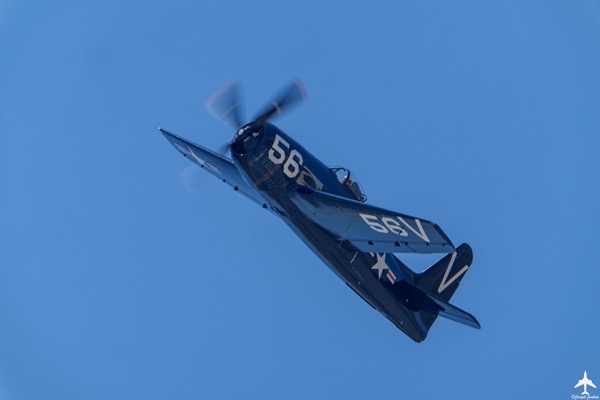
I meant to post this a little while ago, but ran out of time and then got really busy. This was from the June Hangar Talk at the Planes of Fame Air Museum, where they flew their F8F Bearcat.
So let me give you a little bit of information about the Bearcat and how a Bearcat came into existence. First of all, after the Battle of Midway, some F4F wildcat pilots got together with the Vice President of Grumman. They did this in June of 1942 in Pearl Harbor, and they wanted to let Grumman know that to get a good fighter plane you needed to have a plane that had a good climb rate. If you could have good climb rate you need to have good power to a weight ratio. And so to do that you took a light airframe and put the best possible engine you could at the time with that. And that would build a good climb rate plane. So, Grumman started working on that at the end of 1943 and they would call that the F8F Bearcat that you see today. So, what they would need to do is take the F6F, which is the Hellcat, shave off close to 2000 pounds off of that and add in the best engine at the time. So, they did that and the best engine at the time was a Pratt & Whitney R2800 double wasp 18 cylinder air-cooled engine that would produce 2,250 horsepower. So this was a aircraft carrier based fighter, this plane right here. And so, just so you know that, when they built that, it had 20% less weight, 50 miles per hour faster, at 30% better climb rate than the F6F Hellcat of the time. They ended up building 1,265 Bearcats. Unfortunately, because of the end of World War II, the Bearcat never saw any combat action. It ended up being a victim of technology and the jet age, because five years after World War II, came the Korean War, but it became pretty much just an advanced trainer for the United States. From 1946 to 1949, the United States Navy Blue Angels to fly Bearcats in their demo squadron. Let me tell you a little bit about this particular Bearcat. In 1947, Grumman decided to build two Bearcats as civilian models, and he would designate those as 58A and 58B. The one in front of you is 58A, and it was built for Major Alfred Williams, and he was gonna do precision flying, and he was also going to do dive bombing performances for the public. It ended up being sponsored by Gulf Oil Company, and it was called Gulf Hawk 4, and it would be painted white, orange, and black. In 1949, it was severely damaged in a landing incident, and the Planes of Fame was able to acquire it. With the help of other Bearcats over the years, it was restored to the condition that you see today. Its last distinction was as an Air Razor. So in 1964, there was a gentleman by the name of Myra Slovic who flew a stock Bearcat to win the first ever Reno Air Race. And then there was a gentleman by the name of Lau Shelton who would fly a Bearcat by the name of Rare Bear. He would fly and win six National Air Races, and Rare Bear would at the time be the fastest piston engine in the world at 528 miles per hour. Another gentleman by the name of Darryl Greenemeyer would also fly Bearcats. He would also win six Air National Races, and his Bearcat was called Conquest One, and he would retire and donate that plane to the Smithsonian Air and Space Museum in 1977.


 Joseph Jenkins